
Two Chromebooks bought the same afternoon can reach end-of-life years apart. Find out which ones, and when.
The Fleet Lifecycle Planner reads the real manufacture date on every Chromebook, corrects for the platform-release trap behind Google's "10-year" headline, and turns it into a board-ready, per-year and per-school retirement forecast.
Why You Need This
Every Chromebook fleet has an end-of-life date, and it's almost never the one on the purchase order. Google's 10-year ChromeOS update window (the September 2023 policy) is measured from the hardware platform's release date — not the day you bought the device. So a Chromebook purchased in 2020 can sit on a 2017 platform and reach Auto Update Expiration years earlier than "10 years" implies. Two devices bought the same afternoon can hit AUE on different dates.
The Fleet Lifecycle Planner starts from ground truth: when each device was actually built. It pulls a real manufacture date for roughly 94–99% of your fleet — from Google's manufactureDate field, HP and Acer serial-number decoding, and Dell and Lenovo warranty-API ship dates. Then it sets each device's retirement date as the earlier of two lines: your district's shelf-life policy (district-set, default 5 years, anchored to September 1) or its AUE. Whichever bites first is the date that matters.
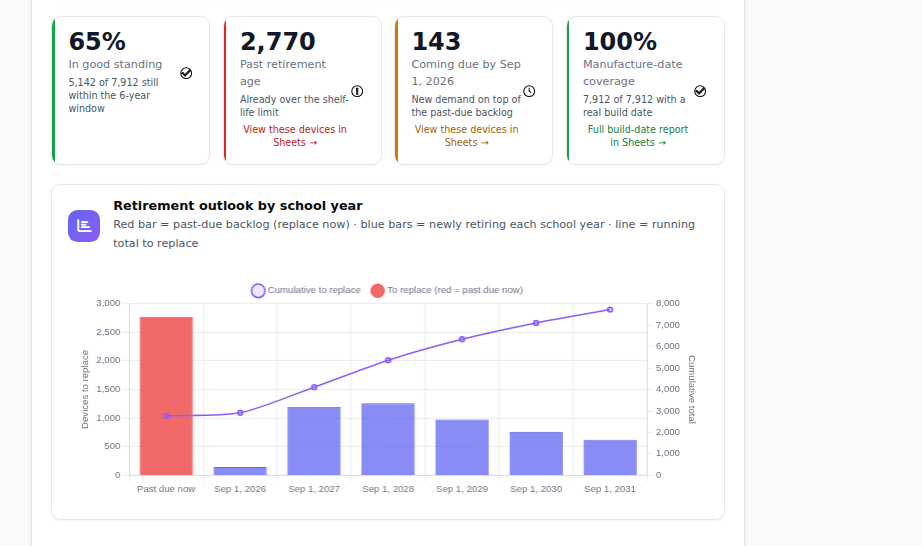
What lands on screen is a plan, not a data dump. You get the past-due backlog — devices already over your retirement line, whether past AUE or past your shelf-life policy — plus a retirement forecast broken out by year and by school, your "% in good standing," your manufacture-date coverage rate so you know exactly how solid the picture is, and one-click export to Google Sheets. It's board-ready without a night of spreadsheet surgery first.
The timing is the hard part. The 2020–21 COVID 1:1 wave was the largest K-12 device purchase in history, and the ESSER federal funding that paid for it expired in September 2024 — leaving a 2025–2027 refresh cliff with no federal money to absorb it. U.S. PIRG's "Chromebook Churn" report (May 2023) found that doubling Chromebook lifespan could save U.S. schools roughly $1.8 billion. The Planner turns that cliff into a schedule you can phase, defend, and act on.
- ✓ Real manufacture dates, not enrollment guesses — sourced from Google's manufactureDate, HP/Acer serial-number decoding, and Dell/Lenovo warranty ship dates, at ~94–99% fleet coverage, with the coverage % shown so you always know how solid the picture is.
- ✓ Corrects the platform-release trap — retirement is computed from when the hardware platform actually shipped, so a 2020 purchase on a 2017 platform doesn't hide behind the "10 years" headline.
- ✓ Whichever line bites first — each device retires on the earlier of your district shelf-life policy (default 5 years, anchored September 1) or its AUE, so age-outs and update-expirations resolve to one honest date.
- ✓ Forecast by year and by school — see how many devices retire each year and in which buildings, so you can pace purchasing across budget cycles instead of taking the cliff all at once.
- ✓ Protect testing and CIPA/E-Rate posture — surface devices crossing AUE, where security patches stop and the admin-console policies your content filtering relies on begin to degrade, before they block a state test or slip out of your filtering.
- ✓ Board-ready in one click — export the full forecast to Google Sheets with "% in good standing" and manufacture-date coverage already computed, for the budget conversation or the board packet.
Common Use Cases
Beat the 2025–2027 refresh cliff
The COVID 1:1 fleets are aging out at the same time ESSER funding is gone. Filter to devices retiring in the next 24 months, see the count broken out per school, and walk into budget season with a defensible multi-year phase-out — waves across 2025–2027 — instead of financing the whole fleet in one emergency purchase.
Clear the fleet for state online testing
State testing platforms eventually block devices as ChromeOS falls behind after AUE. Before the testing window, pull the past-due backlog and anything expiring this school year, and swap out at-risk devices on your schedule — not on the morning a lab of students can't log in.
Triage the devices that already crossed the line
The past-due view lists every device already over your retirement line while still assigned to students; those past AUE are also no longer getting security patches, on hardware that still holds student data. Your technicians work the highest-risk units first instead of discovering them one help-desk ticket at a time.
Frequently Asked Questions
How is this different from the AUE date in the Google Admin console?
The console shows you a date. It doesn't correct for the fact that Google's 10-year clock starts at platform release, not your purchase — so a device you bought recently can be much closer to end-of-life than the console implies. The Fleet Lifecycle Planner starts from the real manufacture date, cross-checks AUE against your own shelf-life policy, and rolls it into a per-year, per-school forecast instead of a per-device lookup.
Why not just count 10 years from when we bought the devices?
Because Google's 10-year update window is measured from the ChromeOS platform's release date, not your purchase date. A Chromebook bought in 2020 can sit on a 2017 platform and reach AUE years earlier than "10 years" implies. Counting from purchase overstates how long your fleet is safe; the Planner corrects for that gap automatically.
Where do the manufacture dates come from, and how complete is the coverage?
From three sources — Google's manufactureDate field, HP and Acer serial-number decoding, and Dell and Lenovo warranty-API ship dates — reaching roughly 94–99% coverage across a typical fleet. The Planner shows your exact coverage percentage, so you always know how complete the picture is rather than trusting a black box.
Can we set our own retirement policy?
Yes. The shelf-life policy is district-set, defaulting to 5 years anchored to September 1. Each device's retirement date is then the earlier of that policy line or its AUE, so your local standards and Google's update cutoff are both respected.
Does it tell me how much the refresh will cost?
Not yet. Today it forecasts device counts and timing — how many devices retire, when, and at which schools — and exports to Google Sheets so you can attach your own per-device pricing. Automatic dollar budgeting is on the roadmap; the counts and timing that drive it are live now.
Why does AUE matter for compliance, not just performance?
After AUE, security patches stop and Google states that existing and future admin-console policies "may not work as intended." The device still powers on — but known CVEs go unpatched on hardware still holding student data, which FERPA's disposal and retirement duties cover, and the admin policies your CIPA/E-Rate filtering depends on begin to degrade. It's a compliance line, not just a speed complaint.
Find out which Chromebooks retire first.
Turn on the Fleet Lifecycle Planner on the Professional plan and get a per-school, per-year retirement forecast built on real manufacture dates — corrected for the platform-release trap and exportable to Google Sheets in one click.